
Every year, as winter gently wraps itself around the hills of Nagaland, something magical happens. People from across India—and even from around the world—travel to this tiny northeastern state to witness the Hornbill Festival 2025, a grand celebration of culture, colour, music, and unity. It is often called the “Festival of Festivals,” and for good reason. Here, the many tribes of Nagaland come together to share their traditions with pride—dances that echo history, food that carries stories, and songs that speak of the mountains. This is not just an event; it is an experience. And today, I will take you there.
Colors, Costumes, and Dance: The Heartbeat of Hornbill Festival 2025
When you enter Kisama Heritage Village, the main venue of the Hornbill Festival 2025, the first thing you notice is the air—fresh, cold, and full of excitement. The village feels like a small world built to celebrate all the tribes of Nagaland. Traditional houses, each representing a tribe, stand proudly. Their roofs are decorated with animal horns, wood carvings, and symbols that tell stories of bravery and ancestry.
As you walk inside, you hear drums in the distance. Their deep, rhythmic beat feels like a heartbeat—steady, ancient, and welcoming. It is almost as if time has slowed down and taken you back to an age when life was simple, when people lived close to the land, and when community meant everything.
Before the festival begins each day, a traditional blessing is offered. You will see elders dressed in their finest shawls, holding spears, wearing headgears decorated with feathers. Their presence alone is powerful. They represent generations of wisdom and tradition that have been passed down like a precious treasure.
And suddenly, the festival begins. You feel the crowd move. You hear cheers. The adventure has started.
Colors, Costumes, and Dance: The Heartbeat of the Festival
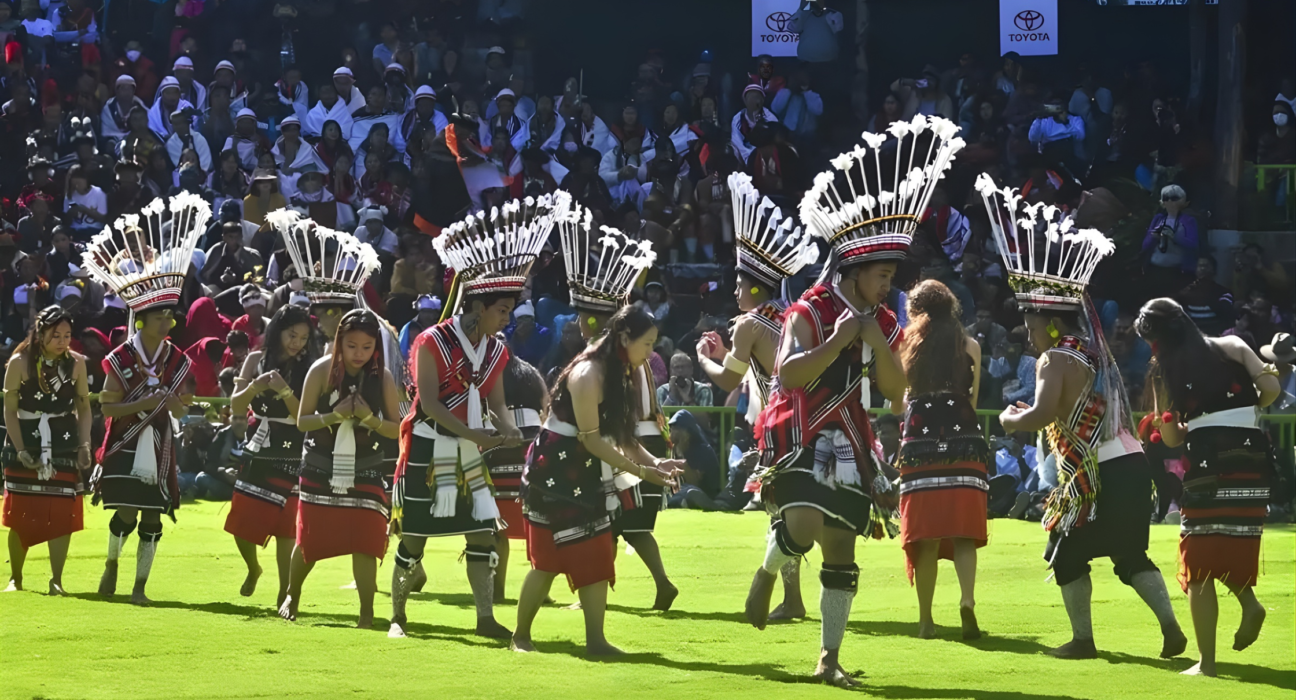
If you were to describe the Hornbill Festival 2025 in one word, it would be vibrant. Every tribe takes the stage with something unique. The dances are not just performances; they are stories—stories about harvest, hunting, war, friendship, love, and victory.
Imagine a circle of men dancing with spears and shields, jumping and stamping their feet to loud chants. Their costumes shine under the sun: red and black shawls, necklaces made of beads, tusks, and shells, headgears adorned with hornbill feathers. Every movement is sharp, bold, and full of energy.
Then, the women join the dances. They move with grace, their jewelry swaying gently, their colorful skirts creating patterns with each step. Their songs carry a softness that balances the strong rhythms of the drums. Together, they create a beautiful harmony—like nature itself.
One of the most mesmerizing things is the unity among the tribes. Even though each tribe has its own style, language, and traditions, they dance for one purpose—to celebrate who they are.
Throughout the day, you can walk around the festival grounds and watch different tribes perform. Sometimes you may not understand the words, but you will feel the emotion in every beat, every movement, and every smile. That is the true language of Hornbill.
Food, Flavours, and Fire: The Warm Soul of Nagaland
A festival is never complete without food, and the Hornbill Festival 2025 is a paradise for anyone who loves trying new flavours. Nagaland’s cuisine is earthy, smoky, spicy, and full of surprises.
Walking through the food stalls is like walking through a marketplace of aromas. One stall offers smoked pork cooked slowly over firewood. Another serves bamboo shoot curry, fresh and fragrant. There are also dishes made with wild herbs, sticky rice cooked in bamboo, and chutneys so spicy they can bring tears to your eyes—but in a good way.
If you are adventurous, try Axone, a traditional fermented soybean dish that is famous for its strong smell and strong flavour. Locals love it, and many visitors develop a deep appreciation for it too.
And then there is the hot rice beer, served in bamboo cups. It is warm, soothing, and perfect for the cold December air.
In the evenings, the festival becomes even more lively. Bonfires are lit, music fills the air, and people gather around to share stories and laughter. This is where strangers become friends. You meet people from different states, different countries, but everyone feels connected by the shared joy of being part of something so special.
Beyond the Festival: A Land of Stories and Smiles
While the Hornbill Festival 2025 is the main attraction, the beauty of Nagaland extends far beyond Kisama Village. Many visitors travel to nearby towns like Kohima to explore the local markets, historical sites, and viewpoints.
The Kohima War Cemetery is a quiet reminder of the past, where soldiers who fought in World War II are laid to rest. Standing there, looking at the neatly arranged graves, you feel a deep sense of respect.
If you love nature, Dzukou Valley is a paradise waiting for you. Just a short trek from Kohima, the valley stretches out like a green carpet between hills, touched by mist and silence. Many tourists plan their trip so they can enjoy both the festival and a trek to this beautiful place.
But what stays with you the most is the warmth of the Naga people. Everywhere you go, you are greeted with smiles. Shopkeepers talk to you like old friends. Artisans proudly explain their crafts. Locals help you find your way even if you do not ask.
By the time the festival ends, you feel like you have lived a small lifetime in just a few days—full of colour, music, stories, and moments that you wish would never end.
Conclusion: A Festival That Stays in Your Heart
The Hornbill Festival is not just an event—it is a celebration of identity, unity, and the incredible diversity of Nagaland. It brings people together, teaches you new things, and opens your heart to cultures you may have never experienced before. Once you visit, the charm of the festival stays with you forever.
Every December, the hills of Nagaland call out with drums, laughter, and the spirit of celebration. And somewhere inside, you will feel the call too—inviting you to return, to experience the magic once more.